
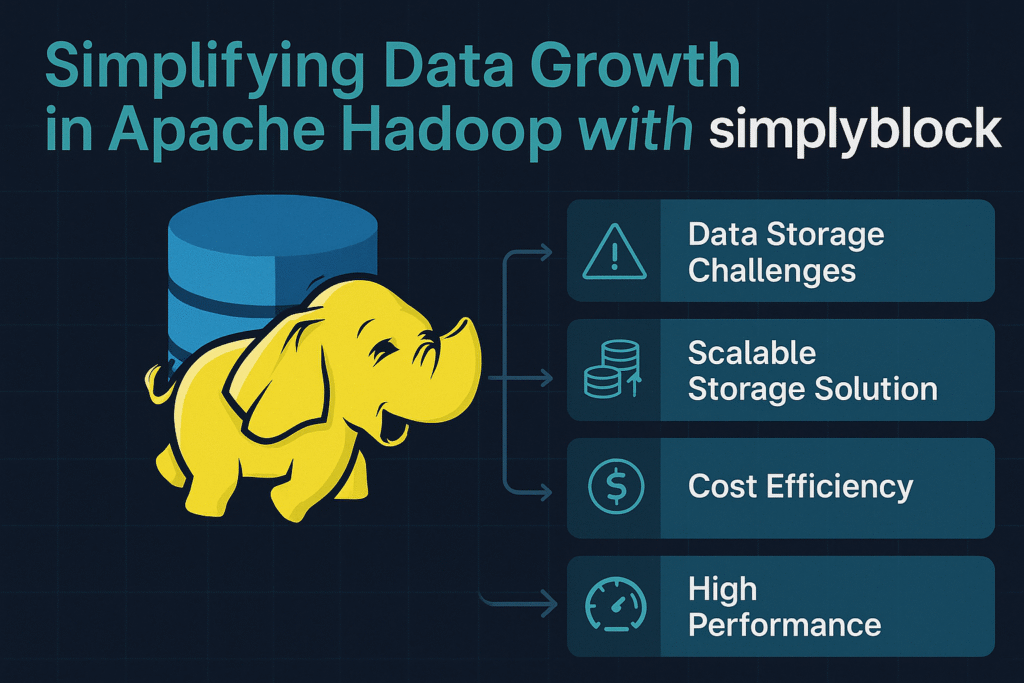
Apache Hadoop powers some of the world’s largest data pipelines. Its distributed design makes it ideal for storing and processing petabytes of data across clusters. But while Hadoop’s compute layer scales easily, storage often becomes a bottleneck. Issues like volumes tied to zones, disruptive scaling, and uneven performance can slow down batch jobs and analytics workloads.
Simplyblock provides a modern answer. With NVMe-over-TCP storage that scales independently of compute, it ensures Hadoop clusters stay fast, resilient, and capable of handling continuous data growth.
How Simplyblock Complements Apache Hadoop
HDFS relies on NameNodes and DataNodes to handle storage blocks. These nodes need consistent, high-throughput volumes to perform efficiently. Traditional cloud storage like EBS often struggles with latency and makes replication across zones difficult.
Simplyblock changes this dynamic. By removing zone dependencies, Hadoop clusters gain the freedom to expand, replicate, and scale without storage limits. Large MapReduce jobs, heavy write workloads, and multi-zone deployments see immediate performance benefits. For teams already focused on simplification of data management, simplyblock adds the backend consistency Hadoop needs to keep scaling.
🚀 Scale Apache Hadoop Storage with Simplyblock
Keep HDFS clusters resilient and ready for large-scale data growth.
👉 See how simplyblock enables multi-availability zone disaster recovery
Step 1: Building Simplyblock Volumes for Hadoop Nodes
Start by creating storage pools and attaching volumes for both NameNode and DataNodes:
sbctl pool create hadoop-pool /dev/nvme0n1
sbctl volume add namenode-volume 200G hadoop-pool
sbctl volume add datanode-volume 1000G hadoop-pool
Connect, format, and mount them:
sbctl volume connect namenode-volume
sbctl volume connect datanode-volume
mkfs.ext4 /dev/nvme0n1
mkdir -p /hadoop/namenode
mount /dev/nvme0n1 /hadoop/namenode
Repeat for DataNodes as needed. Detailed setup guidance is available in the simplyblock documentation.
Step 2: Pointing Hadoop to Simplyblock Storage
With volumes mounted, update Hadoop configs to use them as storage directories. In hdfs-site.xml:
<property>
<name>dfs.namenode.name.dir</name>
<value>file:/hadoop/namenode</value>
</property>
<property>
<name>dfs.datanode.data.dir</name>
<value>file:/hadoop/datanode</value>
</property>
Restart Hadoop services so the cluster begins using simplyblock-backed directories. For the full list of parameters, review the Hadoop configuration reference.
Step 3: Checking the Setup and Monitoring Performance
Verify that Hadoop is using the storage correctly:
hdfs dfsadmin -report
This shows available capacity and block distribution.
On the simplyblock side, check volume health and throughput:
sbctl stats
Combining Hadoop’s built-in reporting with simplyblock monitoring gives administrators full visibility. This level of insight also helps organizations pursuing reduction of RPO and RTO in their big data systems.
Step 4: Expanding Hadoop Storage Seamlessly
Growing storage shouldn’t interrupt running jobs. With simplyblock, you can resize volumes and extend the filesystem without restarting services:
sbctl volume resize datanode-volume 2000G
resize2fs /dev/nvme0n1
This ensures Hadoop pipelines continue to run smoothly as capacity grows. It’s also a major advantage for enterprises balancing performance with cloud cost optimization through AWS storage tiering.
Step 5: Fine-Tuning Hadoop for Maximum Throughput
To get the best performance, deploy Hadoop clusters on EC2 Nitro-based instances to maximize NVMe bandwidth. Match Hadoop’s default 128MB block size with simplyblock tuning for sequential jobs. Spreading data across multiple volumes increases concurrency and efficiency.
Monitoring with iostat, sbctl stats, and Hadoop’s own dashboards helps spot potential bottlenecks early. For AWS-specific tuning, the NVMe Nitro guide provides additional insights.
These same best practices also benefit teams building software-defined storage strategies around Hadoop.
Keeping Hadoop Clusters Scalable and Reliable
Apache Hadoop was built for distributed computing, but without the right storage, scaling introduces risks. Simplyblock ensures storage grows with the workload, provides low-latency performance, and delivers resilience across zones.
That means faster analytics, fewer bottlenecks, and smoother operations at scale. By aligning storage flexibility with Hadoop’s distributed architecture, simplyblock helps organizations keep pace with ever-increasing data demands.
Other supported platforms
If you’re running other Apache data platforms alongside Hadoop, Simplyblock also strengthens storage for:
Questions and Answers
Apache Hadoop is a leading open-source framework for processing and storing large datasets across distributed clusters. Its scalability and cost efficiency make it a preferred choice for enterprises managing petabytes of structured and unstructured data in industries like finance, telecom, and retail.
As data volume increases, Apache Hadoop clusters often encounter storage bottlenecks, high costs, and complex scaling requirements. Traditional storage systems can slow down processing jobs. Simplyblock addresses these issues with NVMe-backed storage that boosts throughput and reduces latency for Hadoop workloads.
Simplyblock helps manage Hadoop’s rapid data growth by delivering elastic, high-performance storage that integrates seamlessly with existing clusters. With cloud storage cost optimization, organizations can scale Hadoop storage efficiently while reducing expenses.
Yes, Hadoop workloads can be containerized and managed on Kubernetes, but performance depends heavily on storage. With NVMe-TCP Kubernetes integration, simplyblock ensures Hadoop jobs achieve faster processing, reduced latency, and simplified scaling in modern environments.
To set up Apache Hadoop with simplyblock, provision NVMe over TCP volumes to Hadoop nodes, or configure persistent volumes in Kubernetes-based deployments. Simplyblock automates provisioning, replication, and snapshots, ensuring Hadoop storage remains reliable and easy to expand as data grows.